Showing posts with label science. Show all posts
Showing posts with label science. Show all posts
Wednesday, February 1, 2017
Download Design Science MathType 6 9 Full Version with crack
Download Design Science MathType 6 9 Full Version with crack
Download Design Science MathType 6.9 Full Version (with crack)
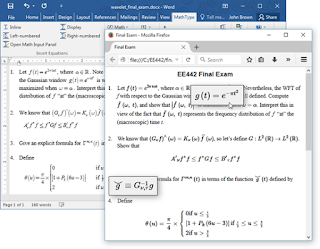
Math handwriting recognition
Handwrite math in MathType or Microsoft Word: Insert handwritten expressions into MathType or Microsoft Word using the Math Input Panel on Windows 7 and later.
Allows entry of handwritten math using the mouse, a tablet, or a touchscreen: Math can be entered using a variety of devices, including a standard mouse. However, better results will be obtained using a tablet or a touchscreen.
Build larger equations by combining handwritten sub-expressions in MathType: While it is easy to handwrite short mathematical expression, longer ones are much harder. MathType lets you have the best of both worlds by allowing you to use its point-and-click editing window to combine multiple hand-written expressions.
MathType works with many applications and websites
Math Everywhere and Anywhere: Up until now, MathType has been thought of mostly as a tool that works with Microsoft Word and PowerPoint. But it has always been much more than that. MathType currently works with 800+ of the most popular applications and websites used by education, web authoring, engineering, and computational systems.
MathType Application and Website Compatibility Database (see Works With ...): We have built an online database of over 1,000 applications and websites, 800+ of which MathType already works with. MathType includes help pages for many describing the best way to work with them. If your favorite application or website is not in the list, MathType probably still works with it using one of the general techniques and mechanisms listed below.
Insert Object (OLE): Many applications have an Insert Object command that allows MathType equations to be inserted into their documents just as in Microsoft Word and other Office applications. This is also called OLE (Object Linking and Embedding).
Cut, copy, and paste: Any application that lets you paste an image from the clipboard or insert one from the toolbar will work with MathType, allowing you to insert equations into literally thousands of document types.
Paste a table from a spreadsheet, document, or web page into MathType as a matrix: MathType lets you copy a table from a spreadsheet (e.g. Excel), document (e.g. Word), or web page, and paste it into MathType as a matrix.
Drag and drop: Just like cut and paste, drag and drop can be used to put equations in many kinds of documents.
Equation image files: MathType can save equations as image files in these formats: EPS, GIF, or WMF. Many applications allow you to import these into their documents.
MathML, TeX, LaTeX import and export: Now you can import and export mathematics defined using MathML or TeX to/from the many applications that work with those formats. MathML code can be either in the new MathML Clipboard Format that is supported by a growing number of mathematical and scientific applications or plain text such as from an XML editor, for example. MathML or TeX can be imported via cut and paste or drag and drop.
Translators for TeX, MathML, Maple, Mathematica, MATLAB, Gmail, Physics Forum and more: MathType has many built-in translators that adapt it to work with various languages, products, and websites. We are continuing to develop new translators and, using our MathType SDK, you can customize them or create your own.
AND MUCH MORE!
DOWNLOAD LINK
http://k2s.cc/file/afc4c7ab2993e/Design_Science_MathType_6.9.rar
Available link for download

Tuesday, January 31, 2017
Google Science Fair 2016 howcanwe make things better with science
Google Science Fair 2016 howcanwe make things better with science
The 2016 Google Science Fair opens for submissions today. Together with LEGO Education, National Geographic, Scientific American and Virgin Galactic, we’re inviting all young explorers and innovators to make something better through science and engineering. To learn more about the competition, how to enter, prize details and more, visit the site, and follow along on Google+ and Twitter.
In this post, 2015 Grand Prize winner, Olivia Hallisey, joins us to reflect back on her own experience with Google Science Fair. -Ed.

I had always been curious and interested in science, and knew I wanted to submit a project, but didn’t really know exactly where to begin. I asked my teacher for his advice on selecting a research topic. He encouraged me to choose something that I felt passionate about, or something that outraged me, and told me to look at the world around me for inspiration. So I did. At that time, the Ebola crisis was all over the news. It was a devastating situation and I wanted to help be a part of the solution. I had found my project.
With the outbreak spreading so quickly, I decided that I wanted to find a way to diagnose the virus earlier so that treatment could be delivered as quickly as possible to those who were affected. I read online about silk’s amazing storage and stabilizing properties, and wondered if I could use silk to transport antibodies that could test for the virus. After many failed attempts (and cutting up lots of cocoons) I finally succeeded in creating a temperature-independent, portable, and inexpensive diagnostic test that could detect the Ebola virus in under 30 minutes. I was really excited that my research could help contribute to saving lives, and I was proud to be selected as the Grand Prize winner a few months later.
As the 2016 Google Science Fair launches today, I wanted to share a few tips from my own experience: First, as my teacher once guided me to do, look at the world around you for ideas. If you’re stuck, try the Make Better Generator to find something that excites or inspires you. Second, find a mentor who’s interested in the same things as you. There are a lot of helpful ideas on the GSF site to get you started. And finally, don’t get discouraged—often what first appears like failure can teach you so much more.
I urge other teenagers like me to take this opportunity to find a way to make the world around them better. Every one of us, no matter our age or background, can make a difference—and as young people, we’re not always so afraid to try things that adults think will fail. But change doesn’t happen overnight, and it often starts with a question. So look at the world around you and challenge yourself to make something better.
Science isn’t just a subject—it’s a way to make things better. So I hope you’ll join the conversation and enter the Google Science Fair this year. Our world is waiting to see what you come up with!

Available link for download
Saturday, January 28, 2017
Supporting our young scientists through the Google Science Fair
Supporting our young scientists through the Google Science Fair
Mariette DiChristina is the Editor in Chief and senior vice president of Scientific American—the first woman to hold the role in the magazines 170-year history. She has been a Fellow of the American Association for the Advancement of Science since 2011 and served as president of the National Association of Science Writers in 2009 and 2010. She joins us here today to share her perspective on the Google Science Fair, which is in its fifth edition this year. -Ed.
This marks my fifth year with the Google Science Fair. In October 2010, when I had my first conversations with my friends at Google about their idea to create a global online science fair that any kid 13–18 could participate in, I thought it sounded pretty cool. But I couldn’t then imagine just how inspiring and powerful such a competition would turn out to be in reality.
At the time, I hadn’t even been editor in chief of Scientific American for a year, but I had real ambitions to try to do something to make a difference in educating our young people about science. You see, I believe that science is the engine of human prosperity—it’s the way we grapple with some of the world’s most challenging problems, from cures for diseases to living sustainably in a finite world. So I’ve always seen the idea of fostering evidence-based thinking in our next generation of global citizens as vital.
Now, five years later and working with partners LEGO Education, National Geographic and Virgin Galactic, the Google Science Fair has an impressive track record of enabling our world’s young scientists to shine. Over the years, they’ve tackled serious issues, like world hunger and the energy crisis. Their projects have worked on how to diagnose and treat diseases like cancer and Alzheimer’s. They’ve engineered flashlights powered by their hands and plastics made of banana peels. And to date, the fair has provided almost $1 million in scholarships, and sent four grand prize winners on trips around the world to further their scientific passions.
Tonight we added some new winners to that list as we recognized and celebrated the 2015 top 20 finalist projects and the bright young scientists behind them:
- The Grand Prize went to Olivia Hallisey for creating a novel way to detect Ebola.
- Girish Kumar won the Google Technologist Award for helping improve learning through auto-generated study questions.
- The National Geographic Explorer Award went to Deepika Kurup for her idea to use solar-powered silver to create clean drinking water.
- Krtin Nithiyanadam’s project focused on improved diagnosis and treatment of Alzheimer’s Disease and won him the Scientific American Innovator Award.
- Pranav Sivakumars automated search for gravitationally lensed quasars earned him the Virgin Galactic Pioneer Award.
- And Anurudh Ganesan took home The LEGO Education Builder Award for his unique twist on effectively transporting vaccines.
If you didn’t get to tune in, you can still watch the Awards Show live stream and check out the complete list of impressive finalists and winners, including our first ever Inspiring Educator, Aydan Meydan from Bosnia and Herzegovina.

In all of these finalists and the thousands of submissions from students in 100+ countries, we see something common. These students are inventive, thoughtful, and determined to help make the world a better place. All they need is a chance and a platform to do so. And, unlike some of us adults, they are ready to try things that other people think are “impossible.” I find them inspiring.
It’s imperative for us to support and encourage our young people to explore and challenge the world around them through scientific discovery. So we’re especially glad that Ahmed Mohamed—the 14-year-old clock maker from Texas—took us up on our invite to attend this year’s event. Curious young scientists, inventors and builders like him should be encouraged and empowered.

So start thinking of your ideas for next year! We can’t wait to see what you’ll try next.
Available link for download
Subscribe to:
Posts (Atom)